
Manufacturing medical devices in a Class 8 clean room, under an ISO 13485 quality system, keeps every part clean and traceable. It also shortens the path to market. Below we explain what each standard requires. Then we show how Rimoni manufactured the CNOGA All-In-One device for non-invasive blood sugar measurement, from the design stage through injection molding.
What Is a Class 8 Clean Room?
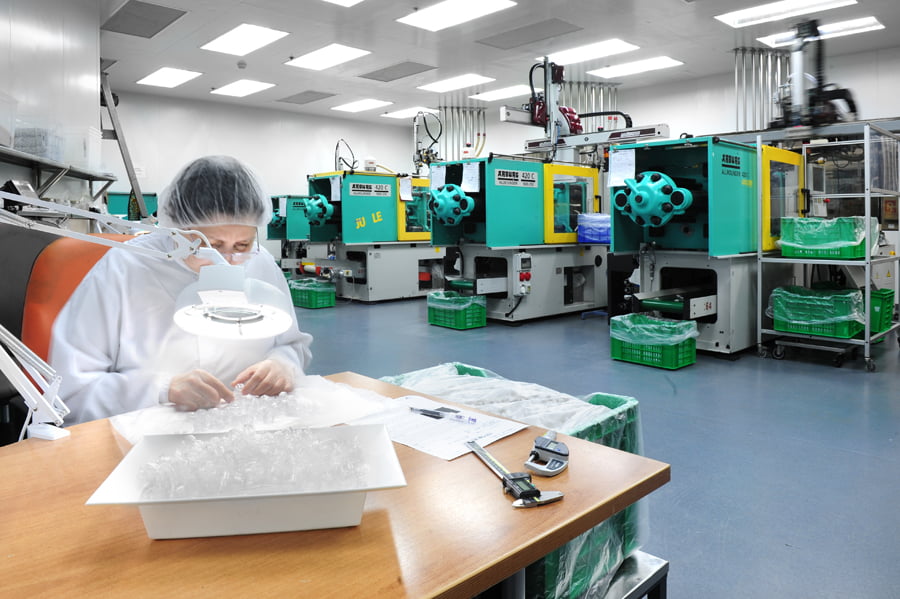
A Class 8 clean room, also called ISO 8 or Class 100,000, limits the number of particles in the air. The limit is 3.52 million particles of 0.5µm per cubic meter of air. In addition, the room replaces its air 10 to 25 times every hour.
Rimoni runs an ISO 8 production line that holds ISO 13485 certification. We dedicate this line to medical products and to components that need careful hygienic assembly.
How a Class 8 Clean Room Lowers Costs
Fewer particles in the air mean less contamination on each part. As a result, parts need less re-sterilization and fewer batches end up in the trash. In the end, the customer pays a lower total cost for the product.
ISO 13485: The Quality System Behind Every Part
ISO 13485 is the international quality standard for medical device manufacturing. It requires risk management and a complete Device History Record (DHR). It also requires IQ/OQ/PQ validation at every stage. Rimoni holds ISO 13485 certification for the manufacturing and injection molding of plastic components, including work inside the clean room.
For the customer, this brings two business benefits. First, FDA and EU-MDR approvals move faster, because the traceability reports are ready in advance. Second, process data such as pressure, temperature and Cpk stays open to the customer.
Case Study: The CNOGA All-In-One Device
The All-In-One device measures 15 biological parameters, glucose among them, without a needle. After each test, it syncs the results to a telemedicine cloud. Rimoni took part in every stage of the project:
- Industrial design: We gave the device a friendly clinical look that does not scare patients. As a result, more users adopted it.
- Engineering and development: We fitted the PCB, the screen and the LED sensors into a precise plastic body.
- Prototypes and mold making: We built hardened steel multi-cavity molds. This cut the T0 time from 16 weeks to 10 weeks.
- Injection molding in the clean room: We molded the parts in ISO 8 with particle monitoring. Thus, rejects dropped below 3%.
The Result
The device launched on time. Its first production series reached a 97% yield. Because of this, CNOGA kept its clinical plan with no delays.
Want to learn more about material choice for medical parts? Read our engineering plastics and material selection guide.
FAQ: Class 8 Clean Room Manufacturing
What defines a Class 8 (ISO 8) clean room?
A Class 8 clean room allows up to 3.52 million particles of 0.5µm per cubic meter of air. Its air changes 10 to 25 times per hour.
How does a Class 8 clean room reduce costs?
Less contamination means less re-sterilization and fewer destroyed batches. Therefore, the customer gets a lower total cost.
What does ISO 13485 include in the manufacturing process?
It includes risk management, full DHR documentation and IQ/OQ/PQ at every stage. In addition, the customer can see the process data, such as pressure, temperature and Cpk.