
Engineering solutions for sealing and durability in modern defense systems. Tactical gear, communication units, night-vision devices and electro-optical enclosures have to work reliably in harsh field conditions. Water, dust, oils, severe shocks and mechanical impacts all put pressure on the seal and the grip. Two-shot injection molding (2K) answers these requirements with a single part that comes out of the mold ready for assembly.
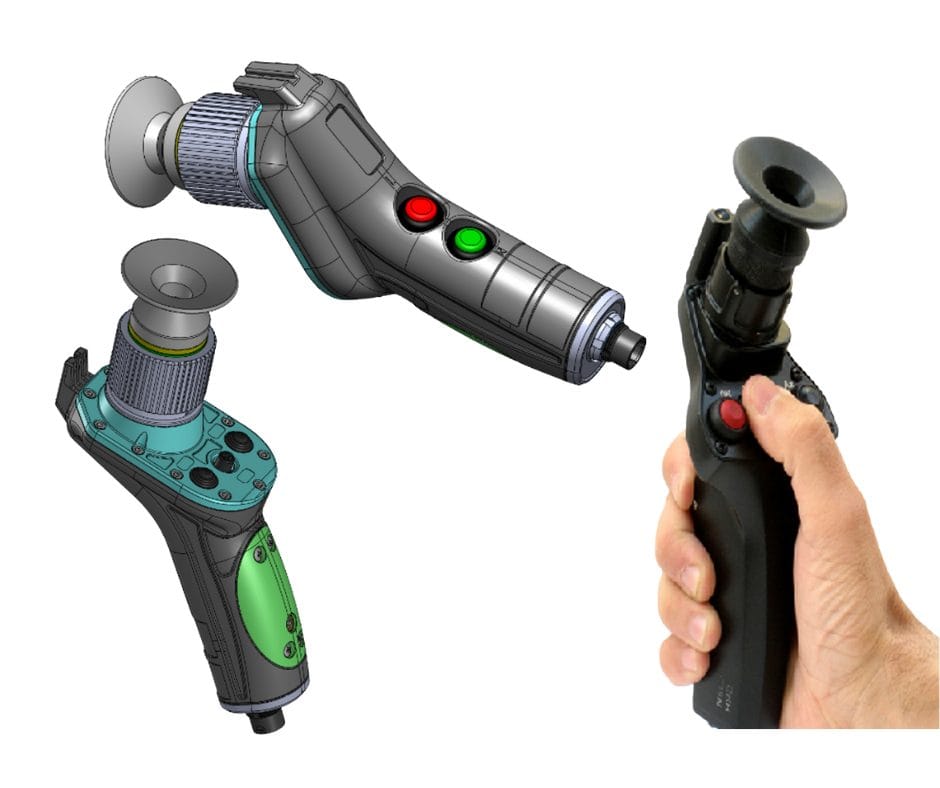
The Challenge: Tactical Housings Built from Many Parts
Traditionally, meeting these requirements meant assembling several separate components by hand. These included a rigid plastic housing, inserted rubber O-rings and a glued elastomer overmold. As a result, every assembly step adds manufacturing cost, creates a potential failure point at the seal joints and lengthens time-to-market.
What Is Two-Shot (2K) Injection Molding?
Two-shot injection molding combines a rigid structural polymer and a flexible elastomer into one unified component during a continuous molding cycle. First, the machine injects the rigid material. Then it molds the elastomer directly onto it, without removing the part. Therefore the two materials form a permanent chemical and mechanical bond, with no adhesives and no manual assembly.
Advantages of Two-Shot Injection Molding in Tactical Systems
1. Sealing up to IP67 and IP68
The process molds a flexible elastomer (such as TPE or TPU) directly over a rigid substrate (such as PC/ABS or PA66). As a result, it forms a continuous seal without micro-gaps. In addition, the chemical bond stops water, moisture and dust from getting in. Furthermore, it removes the need for inserted O-rings that can wear or shift under impact. The IP ratings themselves come from the international standard IEC 60529.
2. Shock Absorption for Sensitive Components
Internal electronics, optical lenses and sensors inside tactical housings must survive severe shocks and drops. The external elastomer layer acts as a built-in shock absorber and dissipates impact energy before it reaches the internal assemblies. This matters most in defense-standard plastic housings for electronics and optics.
3. Ergonomic Grip and Slip Resistance
A TPE layer at the operator’s contact points gives a secure, non-slip grip. For example, it holds firm in wet, muddy or gloved conditions. Moreover, there is no need for secondary spray coatings or adhesive pads.
4. A Simpler Supply Chain and Faster Time-to-Market
A single two-shot molding process replaces several assembly steps. It reduces part counts (SKUs), removes manual labor from the assembly line and keeps quality consistent across batches.
Rimoni Industries’ End-to-End 2K Manufacturing Capabilities
Rimoni Industries provides a complete 360-degree solution for two-shot injection molding projects, from design to serial production, under one roof:
- Engineering and in-house tooling: Rimoni’s in-house mold-making division designs and builds complex 2K molds with tight tolerances for precise material bonding.
- Advanced injection infrastructure: 120 injection molding machines across two manufacturing facilities in Israel (Modi’in and Kiryat Shmona), including specialized 2K machines with rotary tables and core-back capabilities.
- Full quality assurance: one team manages the project from initial DFM and Moldflow analysis through mold fabrication and mass molding. Strict quality control keeps production in line with demanding defense standards.
Further reading on multi-material defense parts: Over-Molding for Military Equipment and What Makes a Plastic Mold High-Quality for Defense Products.
Frequently Asked Questions
What is the difference between two-shot molding and over-molding?
In conventional over-molding, the manufacturer molds the rigid part first and then moves it to a second mold for the soft material. In contrast, two-shot molding performs both shots in one machine and one cycle. This shortens cycle time and gives a more consistent bond.
Which materials are combined in 2K molding for tactical gear?
Typically a rigid structural polymer such as PC/ABS or PA66, together with a thermoplastic elastomer such as TPE or TPU. Engineers choose the pair based on the product’s sealing, durability and grip requirements. Chemical compatibility between the two materials also matters.
Can two-shot injection molding meet IP67 and IP68 requirements?
Yes. With a well-designed interface between the materials, the elastomer layer creates a continuous seal without separate gaskets. However, only testing of the finished product confirms compliance with the standard.