
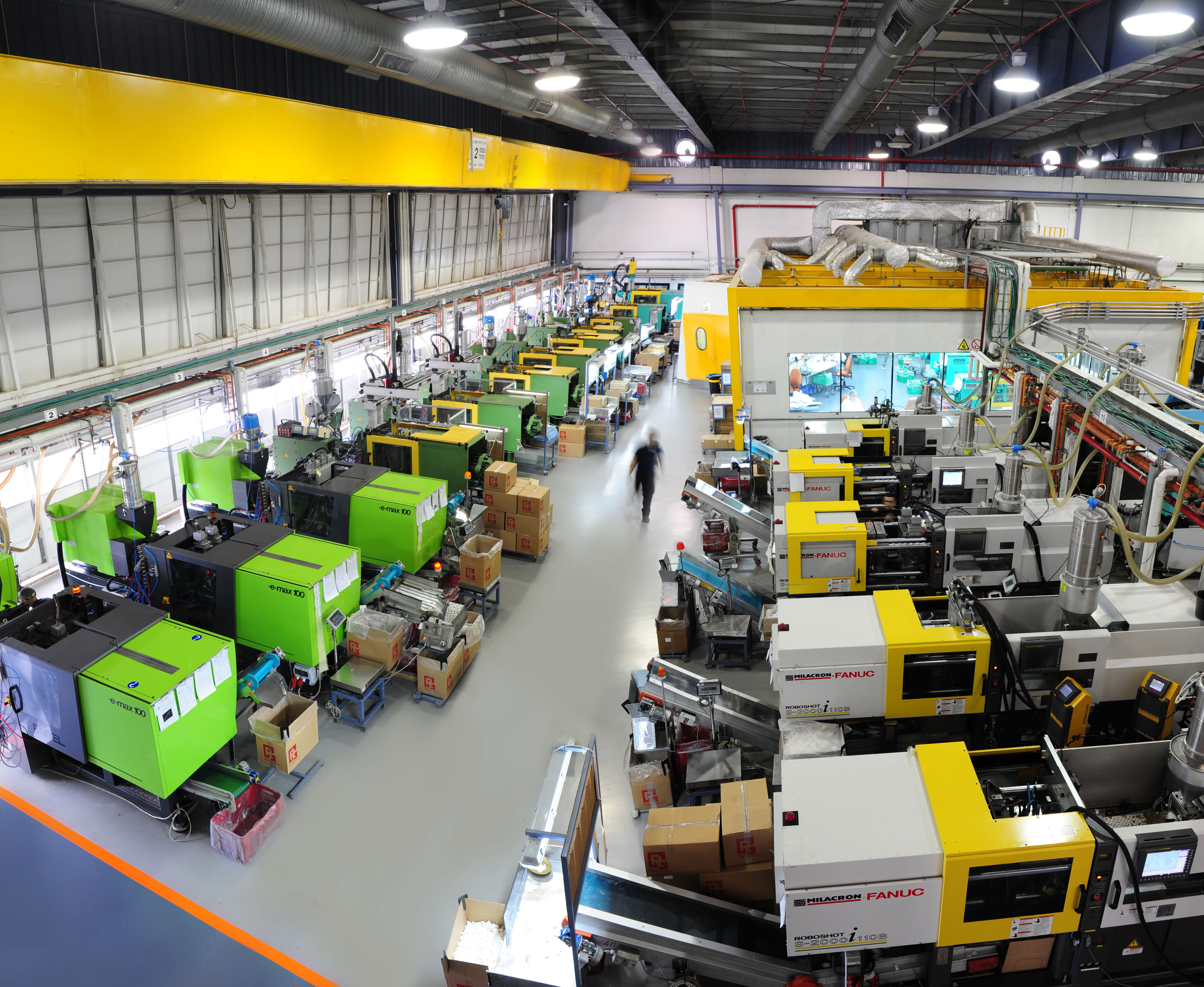
Scientific molding is an engineering approach to plastic injection molding that characterizes and controls the process through measurement, rather than machine adjustment alone. By evaluating filling speed, injection pressure, transfer to packing, cooling and material behavior, manufacturers can establish a process window that supports consistent quality in serial production.
What makes an injection molding process truly reliable?
Producing a part that looks right and meets dimensional requirements is only part of the challenge. The real task is to reproduce that part thousands or millions of times while maintaining dimensional accuracy, mechanical properties and consistent quality.
Scientific molding addresses this challenge through measurement, data, an understanding of polymer behavior and systematic control of process parameters.
Instead of relying solely on operator experience, manual adjustments or trial and error, this approach uses direct measurements and indirect process indicators to understand material behavior in the injection unit and mold. As a result, engineers can identify the factors that influence part quality and establish a controlled, repeatable process window.
This article explains the principles of scientific molding, the key parameters involved and how a structured approach can improve production stability.
What is scientific molding?
Scientific molding is an engineering methodology for developing, optimizing and controlling the plastic injection molding process. It uses measurements and analysis to connect material behavior and processing conditions with the quality of the finished part.
Its purpose is to establish operating conditions that consistently produce parts meeting the specified requirements.
The approach focuses on several core principles:
- Understanding how the material behaves under different processing conditions.
- Measuring and controlling injection velocity and pressure.
- Controlling the transition from filling to packing, known as velocity-to-pressure (V/P) transfer.
- Optimizing packing and holding pressure.
- Establishing appropriate cooling times.
- Evaluating how mold design and cooling affect part quality.
- Defining a process window that accommodates normal production variation.
The principle is straightforward: a successful trial is not enough. Engineers need to understand why the part meets requirements and how to reproduce that result consistently.
With these principles in place, the next step is to examine the variables that can be measured and controlled during each molding cycle.
Which parameters influence the injection molding process?
Injection molding involves interacting stages and parameters. Changing one variable can affect part quality, cycle time and overall process stability.
1. Injection velocity
Injection velocity determines how the molten polymer fills the mold cavities.
Excessive velocity can contribute to flow defects, excessive shear, trapped air or cosmetic problems. Conversely, insufficient velocity can result in incomplete filling, flow lines or more visible weld lines.
Scientific molding evaluates the injection velocity profile and the material’s response during filling to establish a controlled, consistent fill.
2. Injection pressure
Injection pressure is an important indicator of resistance to flow through the injection system and mold.
The pressure required depends on the material, part geometry, wall thickness, flow length and mold design. Monitoring pressure therefore helps identify changes in processing conditions or material behavior.
Pressure measured at the machine’s injection unit and pressure measured inside the mold cavity are different quantities. Each provides a different perspective on the process, and the measurement basis must be clear when comparing data.
3. Velocity-to-pressure transfer
The transition from velocity-controlled filling to pressure-controlled packing is a critical stage of the molding cycle.
Transferring too early can cause underfilling and low part weight. Transferring too late can cause overpacking, excessive mold loading and flash.
In scientific molding, engineers establish the V/P transfer point using process behavior and measurements, rather than estimates alone.
4. Holding pressure and holding time
After filling, packing and holding pressure compensate for volumetric shrinkage as the polymer cools.
Incorrect pressure or timing can contribute to:
- Sink marks.
- Internal voids.
- Part weight variation.
- Dimensional deviations.
- Residual stress.
A useful study examines how holding time affects part weight, including the point at which the gate seals and additional holding time no longer increases part weight.
5. Melt and mold temperature
Melt temperature and mold temperature influence flow behavior, cooling rate, shrinkage and surface quality.
Temperatures that do not suit the material or application can affect product properties, cause cosmetic defects and reduce process stability.
Accordingly, temperature settings should reflect the material supplier’s processing recommendations, part geometry, mold design and actual processing conditions.
6. Cooling time
Cooling is a significant part of the molding cycle and directly affects output and part quality.
Insufficient cooling can lead to warpage, uneven shrinkage and difficulties during ejection. On the other hand, excessive cooling extends cycle time and increases production cost.
Effective mold cooling design, combined with an appropriate cooling time, can improve efficiency while maintaining part quality.
These parameters do not operate independently. Engineers must therefore evaluate their acceptable operating ranges together.
What is a process window, and why does it matter?
A process window is the range of operating conditions within which the process consistently produces parts that meet quality requirements.
For example, rather than selecting a single injection velocity and holding pressure and assuming the process is robust, engineers examine the operating limits within which parts remain acceptable.
A meaningful process window considers:
- Temperature ranges.
- Injection velocity.
- Holding pressure.
- Cooling time.
- Material behavior.
- Mold and machine conditions.
A well-defined process window reduces dependence on manual intervention and improves the ability to maintain quality over time.
However, there is no universal process window. Each combination of material, mold, machine and product requirements needs its own evaluation.
The value of this work lies in its practical outcome: conforming parts throughout complete production runs.
How does scientific molding improve serial production?
Scientific molding replaces isolated adjustments with decisions based on engineering understanding, data and process control.
1. Greater part-to-part consistency
Defined, controlled parameters help reduce cycle-to-cycle variation and support more consistent parts.
2. Fewer rejected parts and less material waste
Early detection of process deviations can limit the production of defective parts, reduce waste and improve efficiency.
3. Shorter setup and adjustment times
A structured development process can reduce repeated trials and uncontrolled parameter changes.
4. Better process reproducibility
Documented conditions make it easier to return to a proven production process and reduce dependence on the knowledge of an individual operator.
5. Better control of manufacturing costs
Process stability can reduce rejects, downtime and corrective interventions, helping improve the total cost of manufacturing a part.
To achieve these benefits, measurement and control must become a documented, repeatable engineering workflow.
How is scientific molding applied in practice?
Effective implementation combines product engineering, mold design, material knowledge and practical injection molding experience.
Step 1: Define the product and material requirements
Review the geometry, tolerances, mechanical properties and cosmetic requirements. At the same time, evaluate the material’s characteristics and recommended processing conditions.
Step 2: Evaluate the mold and injection system
Examine the mold design, feed system, gate locations, venting and cooling. Each influences material behavior during molding.
Step 3: Conduct process studies
Run controlled trials to evaluate how process variables affect filling, part weight, dimensions and quality.
Depending on the application, studies may include short-shot analysis, gate-seal testing and evaluation of the injection velocity profile.
Additional studies, such as relative viscosity, pressure drop and cavity balance, can help establish operating conditions using measured data.
Relative viscosity study
A relative viscosity study examines how changes in filling speed affect the pressure required and the material’s flow behavior. Typically, engineers run a series of controlled shots under consistent conditions and compare filling times and injection pressures.
The objective is to identify a suitable operating region with a relatively stable response to changes in injection velocity. This is a process-based assessment of relative flow behavior, rather than a direct measurement of absolute material viscosity.
Cavity balance study
In a multicavity mold, a cavity balance study evaluates whether the cavities fill similarly.
Engineers use short shots and compare part weights or the degree of fill in each cavity. Differences may indicate an imbalance associated with the feed system, gates, temperatures or mold geometry.
If an imbalance appears, its cause should be investigated before the final process window is established. These studies complement gate-seal testing, V/P transfer evaluation and verification of part quality.
Step 4: Establish operating parameters and a process window
Use the findings to define suitable operating conditions and the limits within which parts meet the specified requirements.
Step 5: Verify the process and establish production controls
Perform quality checks and process verification appropriate to the product and customer requirements. Then document the conditions and define the controls needed for ongoing production.
The scope of engineering work depends on product risk, complexity and customer requirements, rather than a fixed recipe for every part.
Is scientific molding suitable for every product?
The principles apply to a broad range of plastic products. However, the extent of measurement and control depends on the application and its requirements.
- Automotive: Consistency, dimensional and functional compliance, and process control across large production volumes are essential.
- Medical: Quality, documentation, traceability and validation must align with the application and applicable requirements.
- Consumer products: Surface quality, consistent appearance, design requirements and competitive manufacturing costs are important.
- Electrical and electronics: Material selection, dimensions and functional properties must suit the component and assembly.
Across these industries, the goal is the same: a process that can be understood, measured, controlled and reproduced.
How does scientific molding differ from conventional machine setup?
Conventional setup may rely on an operator’s experience and parameter adjustments until parts look acceptable and meet requirements.
Scientific molding takes the analysis further. In addition to identifying settings that produce acceptable parts, it asks why those settings work, where the process limits lie and how the result can be reproduced under different production conditions.
The difference is therefore not simply the number of measurements taken. It is the way engineering decisions are made and the process is managed.
This requires cooperation between product design, mold engineering and production.
How does Rimoni connect mold engineering, injection molding and serial production?
Plastic part quality is shaped well before the molding cycle begins. Product design, material selection, mold engineering and process development all influence the result.
At Rimoni, the combination of product engineering and DFM, in-house mold manufacturing and maintenance, plastic injection molding and assembly supports an integrated view of the product and its manufacturing process.
When a molding issue arises, this approach makes it possible to examine more than machine settings. The investigation can also consider the mold, part design, material and production conditions.
Connecting engineering with the production floor supports continuous improvement in product quality, process stability and manufacturing efficiency.
Consistent quality starts with understanding the process
Scientific molding goes beyond setting up an injection molding machine. It is an engineering approach to understanding the process, measuring influential variables and establishing controlled operating conditions that deliver repeatable quality.
As customers demand greater precision, dependable delivery and tighter cost control, the ability to manage the molding process becomes an important part of a successful manufacturing project.
At Rimoni, quality begins with sound engineering, continues through controlled manufacturing and ends with a product that meets the customer’s requirements.
Developing a new plastic product or facing an injection molding challenge?
Rimoni’s team brings experience in product engineering, mold manufacturing and plastic injection molding, from initial concept to serial production.
Contact Rimoni to discuss how to turn your engineering challenge into a stable, precise and efficient manufacturing process.
Scientific molding: frequently asked questions
These answers summarize the key principles and their application in precision plastic manufacturing.
What is scientific molding in plastic injection molding?
Scientific molding is an engineering methodology that uses measurement, analysis and control of injection molding parameters to establish a stable, repeatable process and consistent part quality.
Which parameters are most important?
Key parameters include injection velocity, injection pressure, V/P transfer, holding pressure and time, melt temperature, mold temperature and cooling time.
What is a process window?
A process window is the range of operating conditions within which parts meet quality requirements. It is specific to the material, machine, mold and product.
How can scientific molding reduce rejects?
By identifying the factors that affect part quality, establishing controlled parameters, documenting the process and detecting deviations early, manufacturers can reduce the risk of producing defective parts.
Is scientific molding suitable for serial production?
Yes. A central objective is to improve process reproducibility and stability across large production runs.
How does mold design affect process quality?
Mold design influences flow, cavity filling, venting, cooling and ejection. Consequently, a well-engineered mold is an important foundation for a stable process.
How does scientific molding differ from trial and error?
Trial and error changes settings until an acceptable result appears. Scientific molding uses systematic studies, measurements and an understanding of cause and effect to establish a process that can be reproduced.