
The Trap of a Fragmented Supply Chain
Companies developing complex technical products across medical, automotive, and industrial sectors face a critical challenge: transitioning smoothly from initial concept to full-scale production. When the manufacturing workflow is divided among separate vendors-such as an external design studio, an overseas mold maker, and a local injection molding facility- communication gaps frequently lead to costly delays and unexpected expenses.
When structural or dimensional discrepancies arise during initial trial runs, a cycle of misplaced responsibility often begins. The mold manufacturer blames the product design, while the injection molding facility points to tooling inaccuracies. Ultimately, the customer bears the financial burden and suffers lost momentum in a competitive market where timing is decisive.
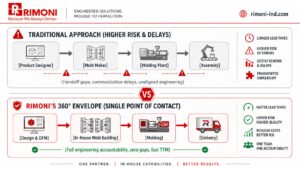
The Engineering Advantage: One Accountable Partner Across the Product Lifecycle
Consolidating the manufacturing lifecycle under a unified 360° operational envelope transforms the development process. Having a single engineering team guide the project from technical feasibility to final packaging eliminates translation errors and operational vulnerabilities.
Design for Manufacturability (DFM)
Tooling and molding engineers join the technical review during the initial concept phase. Defining draft angles, wall thicknesses, and gate locations from a mass-production standpoint prevents late-stage engineering changes that drive up development costs.
In-House Tooling and Maintenance
Designing and constructing molds in-house- while maintaining the capability to onboard and service tooling from external sources- ensures continuous production reliability. When mold adjustments or fine-tuning are required, engineering modifications occur immediately within internal facilities without international shipping delays.
Precision Injection Molding, Cleanroom Services, and Assembly
Controlled molding environments, including cleanroom capabilities for medical devices, advanced composite materials, and strict adherence to international quality standards, ensure fully assembled components ready for market deployment.
Frequently Asked Questions (FAQ)
What is the primary advantage of working with a single-source manufacturing partner?
A single point of contact eliminates handoff gaps and engineering friction between tooling manufacturers and injection molding facilities. This approach reduces development timelines, lowers overhead costs, and maintains consistent batch-to-batch quality.
How does in-house mold making affect response times?
When tooling is designed, maintained, or adjusted in-house, technical modifications take days rather than weeks, keeping production schedules on track.
Which industries benefit most from a consolidated manufacturing approach?
This methodology is ideal for highly regulated, high-precision sectors such as medical devices, automotive components, agricultural irrigation, and complex consumer electronics.